
• Enter your email address to subscribe to this blog and receive notifications of new posts by email.

    Join 78 other subscribers
  • “Writing, to me, is simply thinking through my fingers” — Isaac Asimov

  • Recent Posts

  • Pages

  • Categories

  • Archives

  • Blog Stats

    • 195,069 hits

Reflecting on Student-Created Rubrics

So it’s currently Wednesday as I “pen” this post, and I’m sitting at home reflecting about my day of teaching.

As you might remember, I’ve been on a quest to stretch myself as a teacher while also stretching my students.  My most recent foray into uncharted waters involves having classes create their own rubrics for a small writing assignment.  I blogged about it here.

On Wednesday, students finished writing their rubrics and evaluated each tables’ creations via a Kagan structure called Carousel Feedback.  I’ve used this structure below, and it’s been a popular one.

To keep students accountable, I created this form for each table to complete:

Click to embiggen

I did have to go back and ask students to give specific feedback if the answers to the questions were “yes.”  They were answering yes just to finish quickly.  Being specific required them to dig deeper and justify their responses.

I also had to help students begin answering the questions.  They’d never analyzed a rubric this way, so it was a learning experience for all of us.

After students finished, we began discussing common things they had seen…had a lot of tables left off important skills that needed to be measured?  Which skills needed to be weighted heavier?  Students had assigned percentages (see below) to the skills.  This was the BEST discussion of all because it required students to really analyze what the purpose of the writing assignment was and match it up to the importance of the skills on their rubrics.

I was pleasantly surprised when one of my students insisted that topic sentences be weighted heavily because, in her words, “That’s the main idea, and without it, a reader won’t know what the paragraph is about.”

Hello?  Can I hear a Whoop Whoop?!

I am thinking that perhaps some of the teaching is beginning to stick!

Take a look at a couple of rubrics and evaluation forms my students completed.
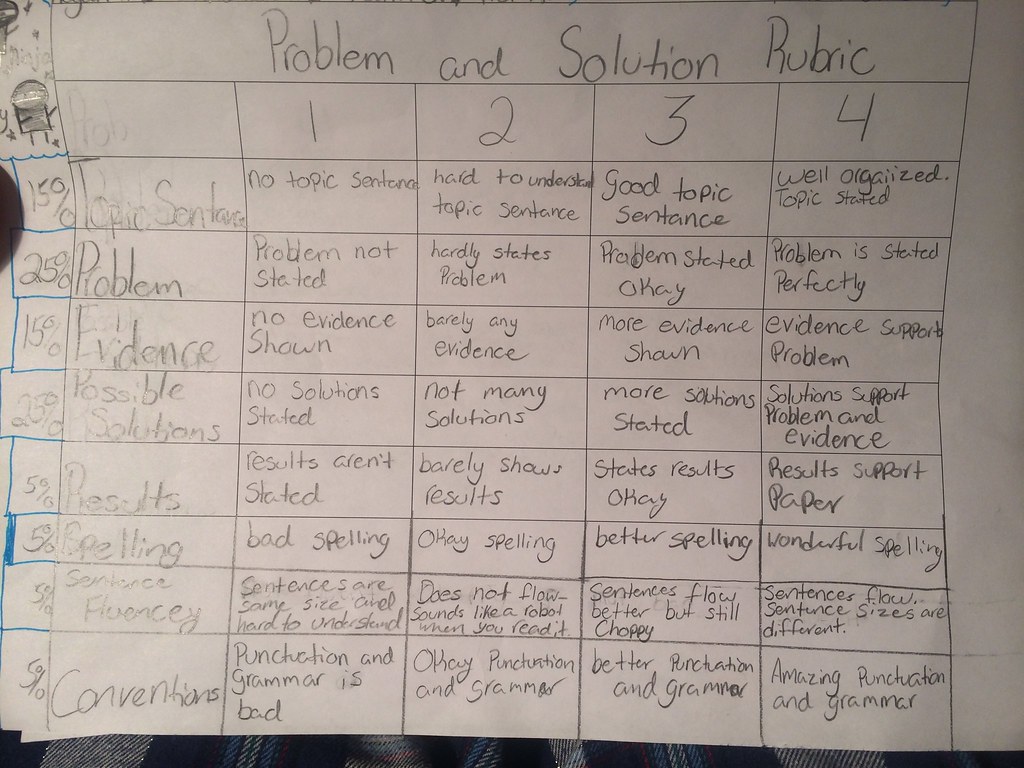
Click to embiggen

Click to embiggen

Click to embiggen
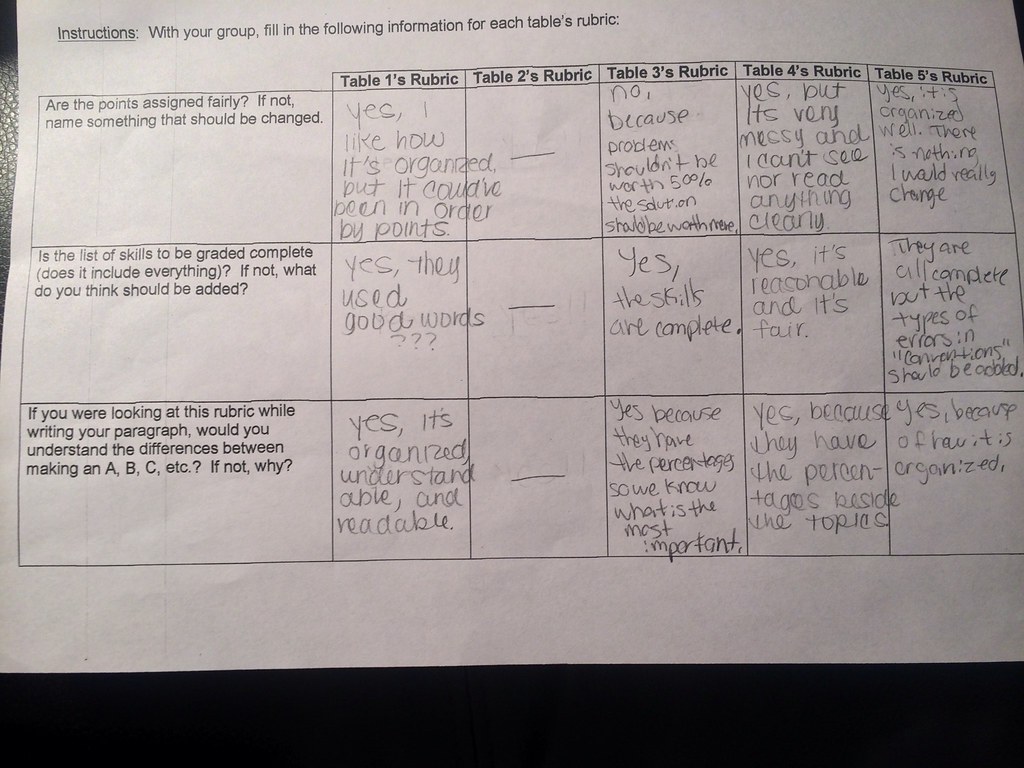
Click to embiggen

We then discussed which skills should be on the final rubric (each class rubric wound up being a little different), and I wrote down these skills under the document camera.  Then, we decided on the weights to assign the skills.

When I got home from work, I filled in the rest of the rubric, using the feedback they had provided on their evaluation forms.  The rubrics I finished Wednesday night looked like this…
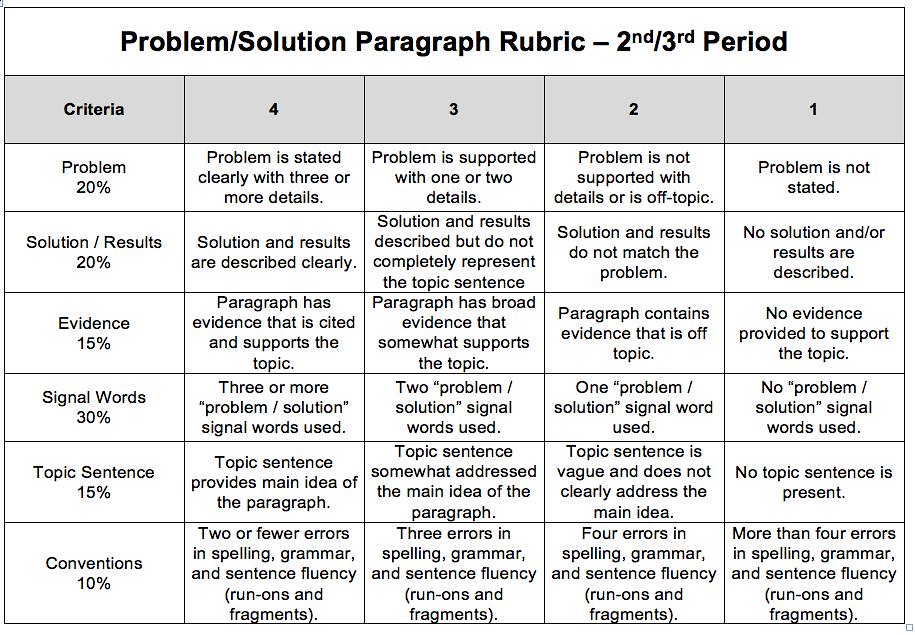
Click to embiggen
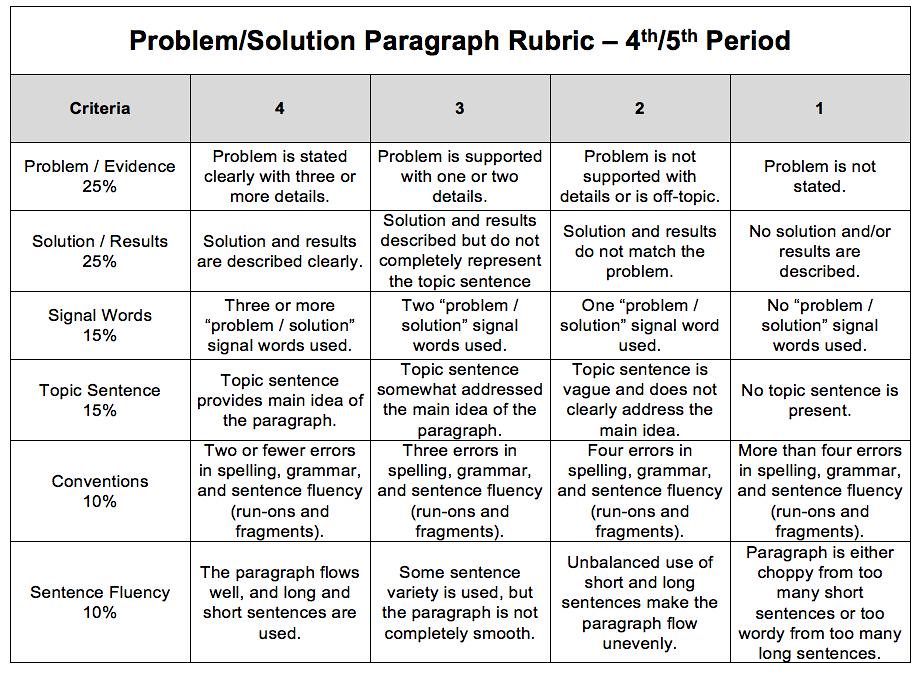
Click to embiggen

This has been an interesting experience.  I wish I’d introduced rubric-creation using non-academic material, but that is something I will change next year when I teach this skill again…earlier in the year.

I also need to teach more skills this way…through real-world tasks.  My students have had a hard time connecting the importance of these skills with FCAT, where they won’t be asked to “create a rubric.”  That may be the case, but they will be asked to analyze, synthesize, and evaluate information…skills they practiced during the creation of the rubric.


Relinquishing Control With Student-Created Rubrics

I absolutely love talking to my friend/mentor, Cinda.

She has been such a blessing to me these last two and a half years.  She always stops what she’s doing to listen to my various ramblings.

She’s great about asking thought-provoking questions that ALWAYS leave me with something to chew on.

Such was the case on Monday when I ran by her office at school.

Now, let me first say that my lesson plans for this week have been finished since the middle of last week.

I was all set to go…

Until she asked me one question…

“Have you thought about the students creating their own rubrics for the assignment?”

Why no, I hadn’t.

My district requires teachers to complete a Self Assessment as part of the yearly IPDP (Individual Professional Development Plan) process.

We are supposed to honestly evaluate ourselves with regard to various things we do in our classrooms.

It’s a humbling experience but very revealing.

One of my goals for this year has been to work my way toward having students create their own assessments.  One step toward this goal is to have them create their own rubrics.

A rubric is what we teachers use (or should use) to grade certain types of assignments.  Any time I give a writing assessment or other project-based task, I provide a rubric ahead of time.

It lists each criterion and the requirements for mastery.

In a nutshell, students can grade themselves ahead of time because they understand the expectations.  There are no surprises, unlike when I was growing up and these things didn’t exist (or nobody used them).

During my first year of teaching, I allowed students to create their own rubrics for one assignment.  It was an interesting experience, but one I have not repeated since then.

Enter in Cinda’s question…

Which got me thinking…

Which I do best in the shower.

I emerged refreshed and ready.

Despite the stress I’m feeling about getting everything taught before FCAT, I decided to stretch my current unit out a bit, temporarily take a break from what we are doing, and use two days (or so…I haven’t fully planned it out yet) to help my students become more metacognitive (thinking about the thinking process).

You’ll see that the standard is the one we’re currently working to master…text structures.  I will have students reflect on the Essential Question when we finish.

The first task will be to analyze components of a couple of rubrics.  These are rubrics that I have used to grade various assignments, so they are familiar with them already.

If I were to be honest, which I always am here on this blog, I’d have to admit that most students barely look at the rubrics despite my going over them in class.  I know that a lot of my words go in one ear and out the other.

By analyzing the rubrics, they have to create their own understanding.

Students will do a lot of brainstorming with those sitting at their tables.  Assigning roles is imperative to student engagement and accountability.  It also prevents students from shirking their responsibilities and hiding.

Next, students will analyze the assignment the rubric will be used to grade (detailed in the shot below) as well as the steps required to complete the assignment.  My thinking is that breaking the task into its various parts will help them create the rubric.

That’s what I have planned for Friday.

I’m not sure how Monday will play out.  I haven’t quite planned out that far yet (as of this writing…which is being done ahead of time).

What I envision is having my students organize the tasks required for the assignment into criteria for the rubric.  I’ll present them with the following example to learn how to weigh each task based on importance.

Each table will then create a rubric for the paragraph they’ll be writing.  Before they write the paragraph, we’ll do a Carousel Feedback activity where I post their rubrics and have them cycle around the room, providing feedback on a form I’ll create.  They’ll share their thoughts, and we will come to an agreement on ONE rubric (made up of different tables’ criteria, if need-be).

I’ll produce that rubric for each respective class.

The final step will be to have students grade their peers’ paragraphs, using the rubrics they created.

I’m kicking myself for not doing this earlier in the year, but I was overwhelmed with the classes I was taking.  Based on how things go and my own reflections, I’ll probably plan this activity for October or November of next school year…after I’ve had a chance to grade them using rubrics I’ve created.

Ultimately, I want this rubric-creation activity to lead into students designing their own assessments.

It’s a scary thing to relinquish control in my room, but it places students in the center of their own learning, which is the main point of Common Core.